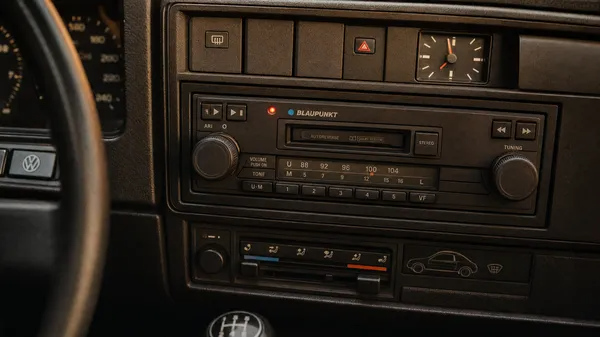

For decades, the humble car radio has been more than just a source of entertainment; for Volkswagen owners, it has also been a silent guardian, protected by a unique PIN code. This security feature, often a source of minor frustration when a battery is disconnected, has a fascinating history rooted in the battle against car stereo theft. This article delves into the evolution of VW radio codes, uncovering some lesser-known facts and the technological shifts that shaped their purpose.
The Genesis: A Response to Rampant Theft in the 1980s
The late 1980s marked a period when car stereo theft was a significant problem for vehicle owners. High-quality car radios, particularly those found in popular models like the VW Jetta and Golf, were attractive targets for thieves. These units, often manufactured by German electronics giant Blaupunkt, were relatively easy to remove and commanded a good price on the black market.
In response to this escalating issue, automotive manufacturers, including Volkswagen, began implementing anti-theft coding systems. The premise was simple yet effective: if the radio was disconnected from its power source (e.g., during a battery change or theft attempt), it would lock down and become inoperable until a specific, unique 4-digit PIN was entered. This rendered a stolen radio virtually useless to a thief, significantly reducing its resale value. To further deter theft, many VW radios featured a blinking red LED, subtly signaling to potential criminals that the unit was coded and therefore a poor target.
Evolution of the Security System: From Analog to Digital
The Analog Era (1980s-1990s)
In the early days, radios such as the “Heidelberg” or “Gamma” models stored their security codes in simple EEPROM (Electrically Erasable Programmable Read-Only Memory) chips. When a code was required, dealers would typically consult physical code books or early computer databases. These databases would match the radio’s unique serial number (often starting with “VWZ…”) to its corresponding PIN. This manual lookup process was a standard procedure for retrieving lost codes.
The Digital Integration (2000s-Present)
As vehicle technology advanced, so did radio security. Modern Volkswagen radios are now deeply integrated into the car’s electronic architecture, primarily through the CAN-Bus (Controller Area Network) system. This integration means that the radio can communicate with other vehicle modules and is often linked to the car’s Vehicle Identification Number (VIN). Consequently, if a modern VW radio is disconnected and then reconnected to the same vehicle, it can often “recognize” the car and automatically unlock without requiring manual PIN entry. This seamless re-pairing enhances user convenience while maintaining security.
For situations where a code is still needed (e.g., installing a radio in a different vehicle or after a system reset), dealers now utilize sophisticated online systems like “ELSA.” This system requires a live connection to Volkswagen’s central servers to retrieve the correct code, ensuring accuracy and preventing unauthorized access.
Unearthing Lesser-Known Facts and Anecdotes
•The Blaupunkt Legacy: For many years, Blaupunkt was the dominant supplier of car radios for Volkswagen. Their distinctive “Blue Dot” logo became synonymous with the audio quality and reliability found in VW vehicles.
•The “Slapped Hands” Incident: There were instances where Volkswagen of America had to caution dealers against providing radio codes without proper VIN verification. This was due to some individuals exploiting dealer access to sell codes online, undermining the anti-theft system’s integrity.
•The “2SAFE” Psychological Deterrent: The infamous “2SAFE” mode, which locks the radio for 60 minutes after two incorrect PIN entries, served as a clever psychological deterrent. A thief would be highly unlikely to remain in a stolen vehicle for an hour with the ignition on, hoping to guess a code.
•Decoding Serial Numbers: The 14-digit serial number found on VW radios (e.g., VWZ1Z2…) isn’t just a random string. The initial characters often indicate the original manufacturer. For example, “VWZ1” typically denotes Blaupunkt, “VWZ2” for Grundig, and “VWZ3” for Philips, offering a subtle clue to the radio’s origins.
Key Manufacturers Through the Years
| Era | Key Manufacturers |
| Early (1980s-1990s) | Blaupunkt, Grundig, Philips |
| Modern (2000s-Present) | TechniSat, Delphi, Panasonic, Alpine |